
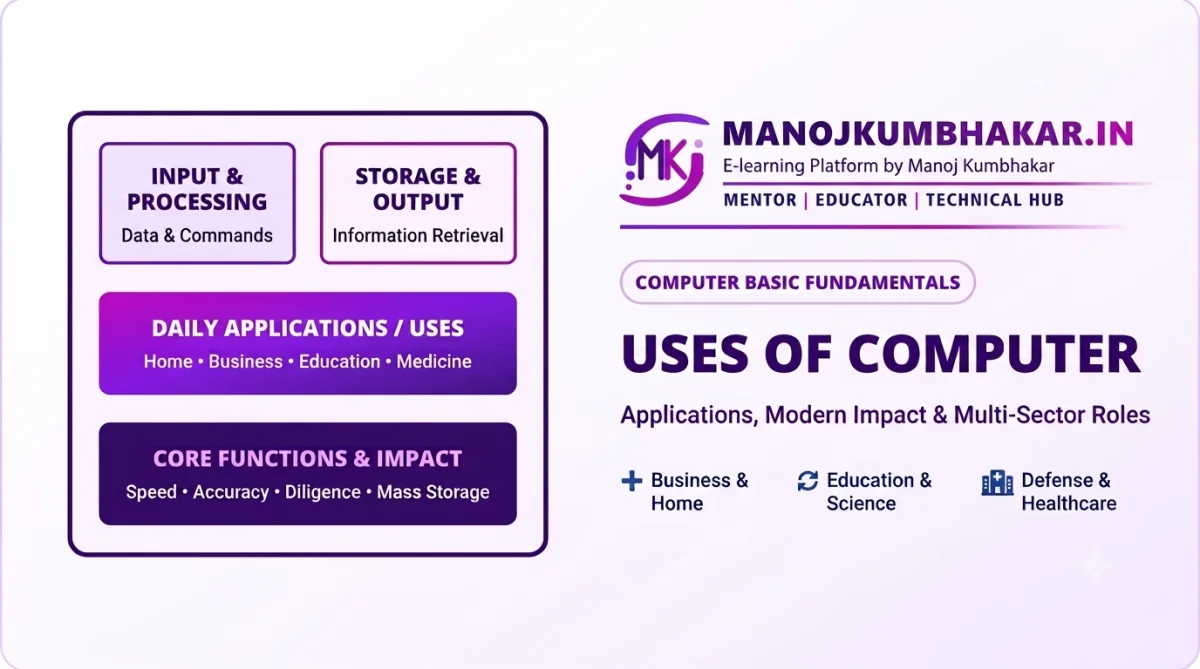
In today’s digital era, the versatile uses of computer technology have completely transformed how humans work, learn, communicate, and solve real-world challenges. From basic household budgeting to operating satellites in deep space, computers have evolved from bulky calculating devices into compact, ultra-fast tools that power our modern society.
Can you imagine modern life without digital devices? Communication, global financial networks, and transportation systems would immediately stop. The primary uses of computer systems stem from their exceptional calculation speed, massive data storage, and absolute mathematical precision. Whether you are an educator delivering virtual lessons, an engineer designing architectural layouts, or a doctor diagnosing critical health conditions, computers simplify complex workflows in seconds.
Table of Contents
- 1. Uses of Computer at Home
- 2. Uses of Computer in Business and Office Work
- 3. Uses of Computer in Education and E-Learning
- 4. Uses of Computer in Science and Engineering
- 5. Uses of Computer in Healthcare and Medicine
- 6. Uses of Computer in Banking and Financial Services
- 7. Uses of Computer in Defense and Military Operations
- 8. Uses of Computer in Sports and Athletic Analytics
- 9. Uses of Computer in Government and Public Administration
- 10. Uses of Computer in Publishing, Media, and Graphic Arts
- Summary Table: Key Uses Across Sectors
- Core Characteristics That Make Computers Indispensable
- Frequently Asked Questions (FAQs)
1. Uses of Computer at Home
Computers have become a vital household tool for family productivity, financial management, and everyday leisure:
- Household Budgeting: Families track monthly grocery expenses, electricity bills, and long-term savings plans using spreadsheet software like Microsoft Excel or Google Sheets.
- Digital Entertainment: High-definition video streaming, digital music libraries, casual gaming, and personal photo management are available instantly on personal computers and laptops.
- Remote Work: Working professionals communicate with colleagues, draft corporate reports, and attend virtual meetings directly from their study tables.
- Personal Communication: Email, messaging applications, and video calling platforms keep people connected with distant friends and family members.

2. Uses of Computer in Business and Office Work
The corporate and commercial sector depends heavily on computer automation to maintain high efficiency and operational speed:
- Employee and Payroll Records: Human Resource teams store employee attendance, salary computations, tax deductions, and provident fund allocations without physical paper clutter.
- Inventory and Stock Management: Warehouses and retail stores use barcode scanners connected to centralized databases to monitor product inventory in real time.
- Accounting and Financial Statements: Commercial accounting software simplifies balance sheets, profit-and-loss declarations, and invoice generation.
- Global E-Commerce: Businesses market products worldwide, collect digital payments, and track order fulfillment through automated online storefronts.
3. Uses of Computer in Education and E-Learning
The modern educational landscape has experienced a massive shift toward smart classrooms and virtual learning environments:
- Online Classes and Distance Education: Students participate in live webinars, download organized digital study notes, and submit homework assignments through web portals.
- Interactive Self-Assessment: Students practice objective questions and test their conceptual knowledge on interactive portals—such as our MCQ Practice Hub—with instant evaluation.
- Digital Libraries and Scholarly Research: Vast academic repositories grant students and university researchers immediate access to research papers, encyclopedias, and historical documents.
- Smart Board Presentations: Instructors present complex diagrams, animated biological systems, and mathematical demonstrations using multimedia projectors.
4. Uses of Computer in Science and Engineering
Scientific researchers and technological innovators were among the earliest users of digital computing machinery:
- Complex Mathematical Simulations: Supercomputers model complex physical phenomena, including molecular structures, atomic reactions, and global climate patterns.
- Computer-Aided Design (CAD): Mechanical and civil engineers create detailed 2D architectural layouts and 3D machine schematics prior to manufacturing.
- Weather Forecasting: Meteorological institutions process atmospheric radar and satellite telemetry data through algorithmic models to predict storms and rain patterns accurately.
- Aerospace and Space Exploration: Agencies rely on automated computer trajectories to launch satellites, monitor orbital telemetry, and guide lunar landers. You can explore computational history via the NASA Computing Technology Archives.
5. Uses of Computer in Healthcare and Medicine
The medical field has benefited tremendously from computer technology, improving patient diagnostics and treatment outcomes:
- Medical Imaging: Advanced diagnostic equipment—such as MRI, CT scans, and ultrasound systems—relies on digital signal processing to generate clear scans of internal organs.
- Electronic Health Records (EHR): Hospitals maintain unified patient profiles containing medical histories, prescription charts, and diagnostic lab reports with secure, instant access.
- Patient Vital Monitoring: Critical care units utilize computerized telemetry to continuously monitor heart rate, blood pressure, and blood oxygen levels (SpO2).
- Robotic Surgical Assistance: Modern surgeons utilize robotic surgical systems to perform complex, minimally invasive procedures with steady precision.
6. Uses of Computer in Banking and Financial Services
Modern financial institutions process millions of transactions every day with total security and mathematical precision:
- Core Banking Infrastructure: Automated databases instantly update account balances, execute direct deposits, and compute interest across branch networks.
- Automated Teller Machines (ATMs): Customers withdraw cash, deposit checks, and verify account balances 24 hours a day using networked cash dispensers.
- Online and Mobile Payments: Secure encryption protocols allow users to transfer funds, pay utility bills, and purchase goods through digital payment gateways.
7. Uses of Computer in Defense and Military Operations
Modern national security relies heavily on computerized intelligence, secure communication networks, and defense hardware:
- Missile Guidance and Radar Systems: Ballistic missile trajectories, unmanned aerial vehicles (drones), and radar tracking systems rely on real-time computer calculations.
- Encrypted Strategic Communications: Armed forces transmit encrypted tactical messages across satellite frequencies to protect national security.
- Personnel and Security Databases: Central databases record military personnel logistics, criminal investigations, and border control details.
8. Uses of Computer in Sports and Athletic Analytics
Athletics and competitive sports tournaments employ computer vision and analytical models:
- Decision Support Systems: Visual trajectory systems—such as Hawk-Eye in tennis and cricket—help referees and umpires review contested line calls.
- Performance Tracking: Wearable athletic sensors record heart rates, acceleration, and physical exertion to assist sports scientists in refining athlete training regimens.
- Live Match Graphics: Real-time point tallies, player statistics, and broadcast graphics update automatically for international television audiences.
9. Uses of Computer in Government and Public Administration
E-Governance platforms bring public services directly to citizens, improving administrative transparency:
- Digital Identity Systems: Central servers record biometric and demographic details for national identity cards, passports, and driver’s licenses.
- Public Utility Management: Citizens file income tax returns, register land deeds, and pay electricity bills through government service portals.
- Direct Benefit Transfers: Welfare programs and subsidies transfer financial assistance straight to the verified bank accounts of eligible citizens.
10. Uses of Computer in Publishing, Media, and Graphic Arts
The creative industries rely on specialized computing applications for daily production:
- Desktop Publishing (DTP): Graphic artists layout textbooks, periodicals, newspapers, and marketing banners using desktop publishing software.
- Audio and Video Editing: Sound producers and video creators cut footage, equalize audio channels, and composite special effects inside multi-track software.
- Animation and Visual Effects (VFX): CGI animators use dedicated 3D rendering engines to create virtual characters, landscapes, and visual assets for major motion pictures.
Summary Table: Key Uses Across Sectors
| Field / Sector | Primary Function | Everyday Practical Example |
|---|---|---|
| Home | Organization & Leisure | Monthly budgeting, video streaming, casual gaming |
| Business | Administration & Commerce | Payroll processing, inventory control, billing |
| Education | E-Learning & Assessment | Virtual classes, interactive tests, digital research |
| Science & Engineering | Modeling & Research | Weather prediction, aerospace control, CAD drafting |
| Healthcare | Diagnostics & Treatment | CT scans, patient vital telemetry, surgical robotics |
| Banking | Transactions & Security | Core banking servers, ATM cash networks, online banking |
| Defense | Strategic Security | Radar surveillance, satellite tracking, drone guidance |
| Government | E-Governance | Income tax filing, digital identity databases, land records |
Core Characteristics That Make Computers Indispensable
- High Execution Speed: Computers execute millions of calculations per second, finishing tasks in milliseconds that would take days manually.
- Consistent Accuracy: Unlike manual calculations subject to human fatigue, computers produce 100% mathematically consistent results when provided correct input data.
- Massive Storage Capacity: Modern Solid-State Drives (SSDs) and hard disks store terabytes of books, databases, and media files in compact devices.
- Multitasking: Modern operating systems and multi-core processors execute several programs simultaneously without system slowdowns.
- Diligence and Reliability: Computing hardware operates continuously without fatigue, emotional bias, or lapse in operational precision.
Frequently Asked Questions (FAQs)
What are the 5 basic uses of computer?
The five most common uses of computer devices include: (1) Online learning and scholarly research, (2) Office accounting and inventory tracking, (3) Healthcare diagnostics and medical record management, (4) Household budgeting and digital entertainment, and (5) Online banking and electronic fund transfers.
Why are computers important in our daily lives?
Computers save valuable time, eliminate calculation errors, and provide instant global communication. By automating routine repetitive chores, computers allow people to concentrate on creative strategy and problem-solving.
How do computers assist students with learning?
Computers give students immediate access to educational articles, interactive video lectures, electronic books, and self-testing quizzes—such as our Computer Basic 1 MCQ Test—to reinforce exam preparation.