
Imagine typing a single sentence into a blank screen and watching a computer write a complete business proposal, compose an original jazz track, or generate a photorealistic product image in under five seconds. That is not science fiction—it is happening right now on millions of laptops and smartphones every day.
If you have heard people talking about ChatGPT, Midjourney, or automated coding assistants and wondered what is generative ai, you are in the right place. Unlike older software that could only follow rigid rules or sort existing spreadsheets, this new wave of artificial intelligence actually creates brand-new content from scratch. In this beginner-friendly guide, we break down exactly how it works behind the scenes and explore 7 real-world examples transforming modern work.
Table of Contents
- 1. What is Generative AI? (Plain-English Definition)
- 2. Traditional AI vs. Generative AI: What Changed?
- 3. How Generative AI Works in 3 Simple Steps
- 4. 7 Best Examples of Generative AI in Action
- 5. Quick Summary: Types of Generative AI Output
- 6. Key Limitations & Safety Tips Every User Should Know
- 7. Frequently Asked Questions (FAQs)
1. What is Generative AI? (Plain-English Definition)
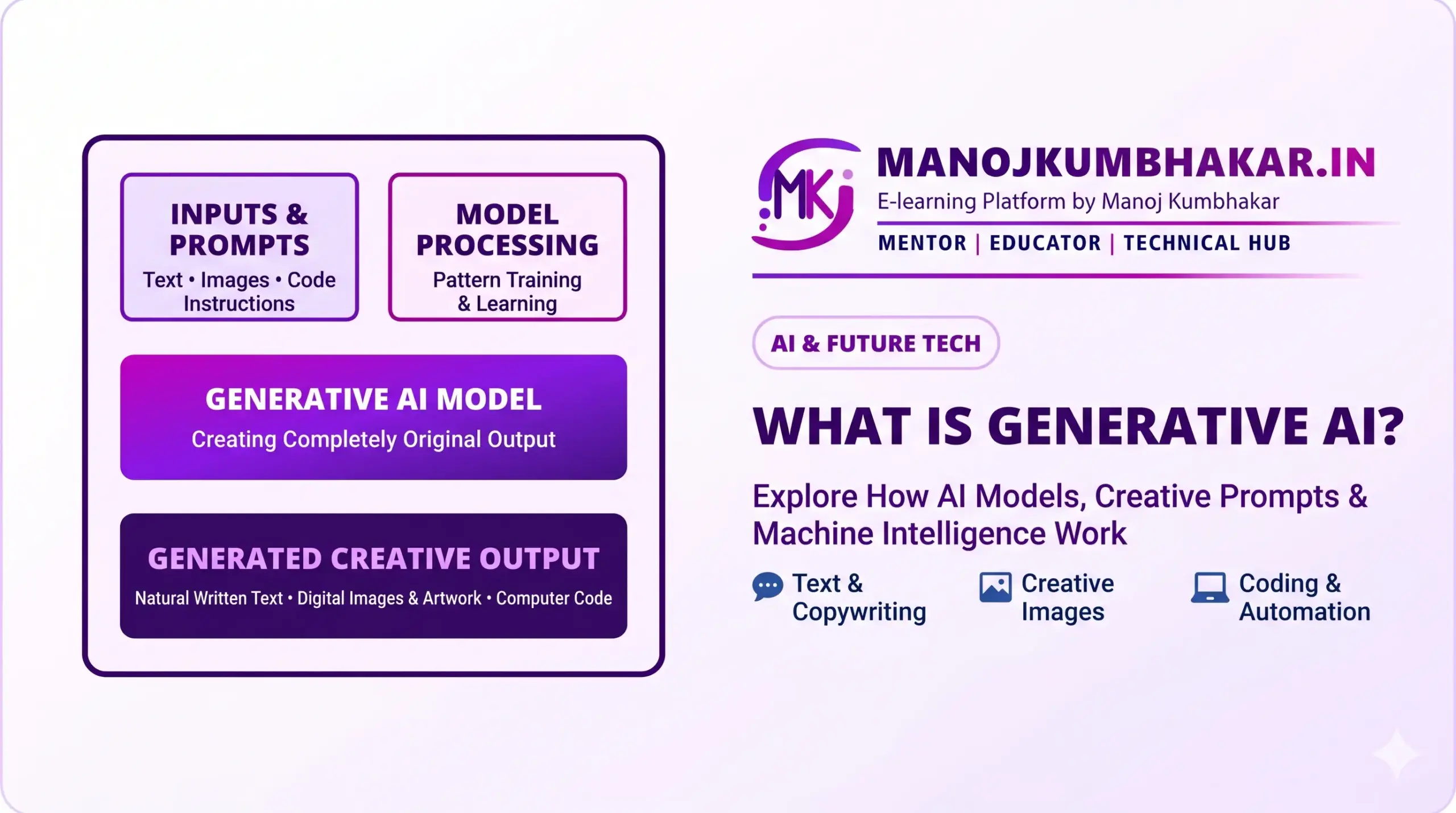
To understand what is generative ai without getting lost in heavy math, think of how a human musician learns to write songs. After listening to thousands of melodies, chords, and rhythms, the musician understands musical patterns well enough to compose a brand-new song that has never been heard before.
Generative Artificial Intelligence works the exact same way. It is a specialized branch of machine learning trained on massive collections of existing text, images, audio, and computer code. Once trained, the system predicts patterns and generates original, human-like content whenever you give it a text instruction—known as a prompt.
2. Traditional AI vs. Generative AI: What Changed?
Artificial intelligence has actually been inside your devices for over a decade, powering spam filters, GPS navigation, and movie recommendations. However, there is a massive difference between classic analytical AI and modern generative models:
- Traditional AI (Analyzes & Predicts): Looks at existing data to classify or predict an outcome. For example, your email app scans an incoming message and decides whether it is “Spam” or “Inbox.” It never writes an email for you.
- Generative AI (Creates & Designs): Uses deep neural networks to produce completely new artifacts. Instead of just sorting your emails, it can draft a polite client reply, summarize a 20-page PDF report, or design a custom presentation slide.
To understand the core computing hardware and system software that make these rapid calculations possible, check out our foundational guide on What is an Operating System.
3. How Generative AI Works in 3 Simple Steps
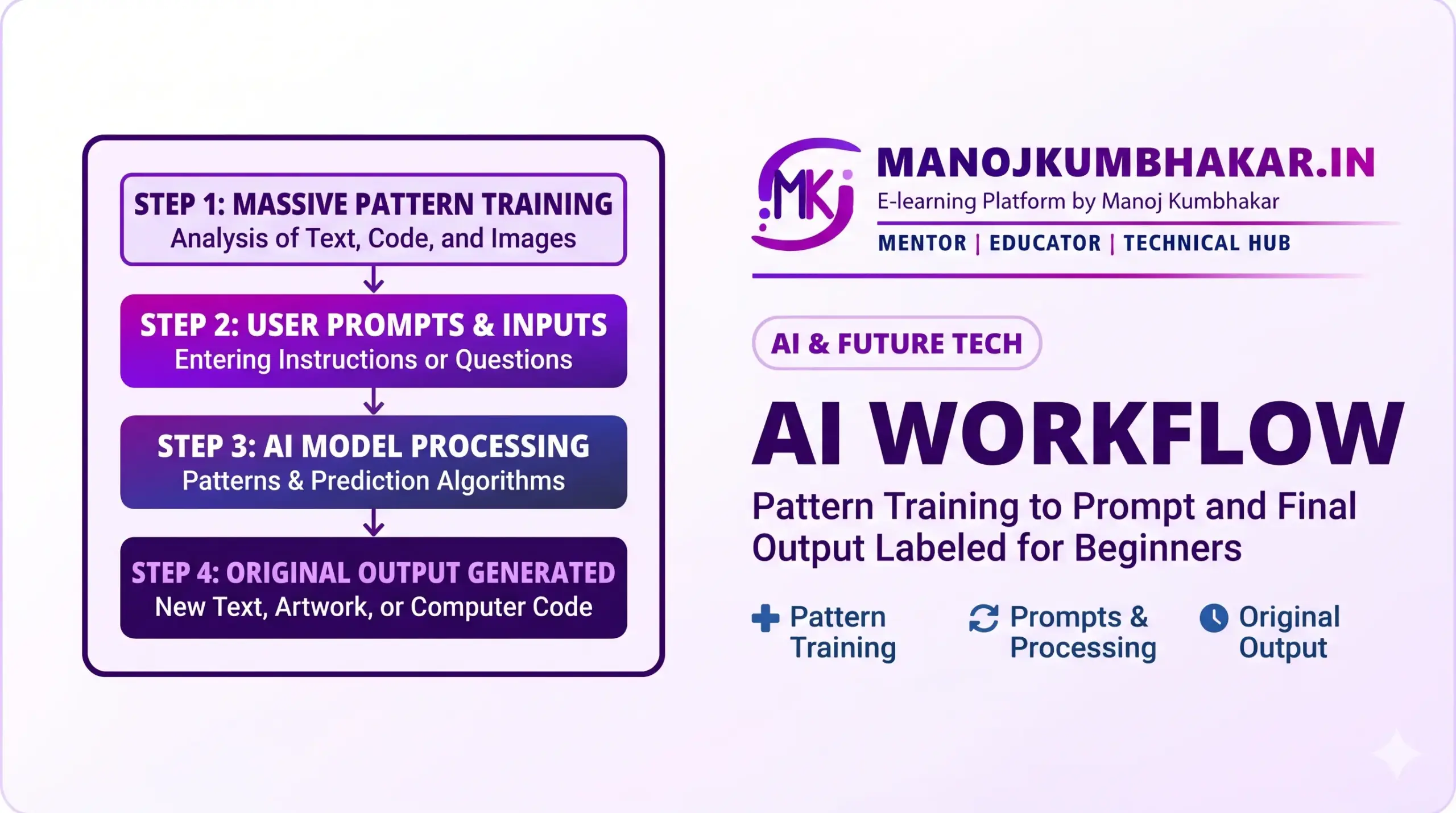
Behind every clean chat window lies a sophisticated engine called a Foundation Model (such as a Large Language Model for text or a Diffusion Model for images). Here is how it turns your idea into a finished result:
- Massive Pattern Training: Engineers feed billions of publicly available books, articles, images, and code repositories into a neural network. During training, the model learns grammar, visual shapes, logic, and context—not by memorizing files like a database, but by learning statistical relationships between words and pixels.
- Prompt Interpretation: When you type a request—such as “Write a 3-bullet summary of renewable energy benefits”—the AI breaks your sentence down into small mathematical units called tokens to analyze your exact intent and tone.
- Token-by-Token Generation: Using probability, the model predicts the single best next word (or pixel) one step at a time until a complete, coherent response appears on your screen in seconds.
For deeper academic research on how foundation models and AI safety standards are evolving globally, you can explore the Stanford Institute for Human-Centered AI (HAI).
4. 7 Best Examples of Generative AI in Action
Generative technology is no longer limited to tech labs. Here are seven practical ways everyday users, students, and businesses rely on it right now:
- Conversational Writing Assistants (ChatGPT, Claude, Gemini): Draft emails, brainstorm blog outlines, translate languages, and break down complex textbook topics into plain-English explanations.
- Text-to-Image Art Generators (Midjourney, DALL-E, Adobe Firefly): Create custom YouTube thumbnails, marketing posters, architectural concepts, and digital illustrations simply by describing the scene in words.
- AI Coding Co-Pilots (GitHub Copilot, Cursor): Suggest real-time code completions, detect software bugs, and translate functions between Python, JavaScript, and PHP in seconds.
- AI Video & Animation Creation (Sora, Runway, HeyGen): Turn written scripts into smooth 1080p video clips, animated explainer scenes, and realistic voice-synced presenter videos without a camera crew.
- Voice Cloning & Music Synthesis (ElevenLabs, Suno): Generate natural-sounding podcast voiceovers in dozens of accents or compose royalty-free background music tracks tailored to a specific mood.
- Automated Customer Support Agents: Modern e-commerce websites deploy intelligent assistants that read order histories, answer product questions naturally, and process returns 24/7.
- Healthcare & Drug Discovery Modeling: Pharmaceutical researchers use generative molecular models to simulate new protein structures, accelerating medicine development from years to months.
5. Quick Summary: Types of Generative AI Output
| Content Format | Underlying Model Type | Popular Real-World Tools | Best Everyday Use Case |
|---|---|---|---|
| Text & Research | Large Language Models (LLMs) | ChatGPT, Google Gemini, Claude | Writing emails, study summaries, brainstorming |
| Images & Graphics | Diffusion Models | Midjourney, Adobe Firefly, Imagen | Blog banners, social media graphics, mockups |
| Software Code | Code-Tuned LLMs | GitHub Copilot, Cursor | Debugging scripts, building web apps faster |
| Audio & Voice | Neural Audio Synthesis | ElevenLabs, Suno | Video narration, accessibility voiceovers |
| Video & Motion | Spatiotemporal Diffusion | Runway, Sora, Veo | Short educational clips, visual storytelling |
6. Key Limitations & Safety Tips Every User Should Know
While generative tools dramatically boost speed and creativity, smart users treat AI as a co-pilot rather than an autopilot. Keep three golden rules in mind:
- Watch Out for “Hallucinations”: Because AI predicts likely word patterns rather than checking a live fact database, it can occasionally invent fake statistics or outdated dates with complete confidence. Always double-check critical facts, medical advice, and financial figures.
- Protect Sensitive Personal Data: Never paste private passwords, bank details, client contracts, or confidential company records into public AI chat windows.
- Add Your Human Touch: Search engines and readers value authentic experience. Use AI to structure ideas and overcome writer’s block, then edit the final draft with your own real-world examples and voice.
7. Frequently Asked Questions (FAQs)
Is Generative AI free to use for beginners?
Yes. Leading platforms including Google Gemini, ChatGPT, and Microsoft Copilot offer generous free tiers that let beginners write text, analyze documents, and generate images without paying a monthly subscription.
Will Generative AI replace human jobs?
In most industries, AI replaces repetitive tasks rather than entire professions. Professionals who learn how to use AI tools to speed up research, writing, and data analysis consistently outperform those who ignore the technology.
What is a prompt in Generative AI?
A prompt is the text instruction, question, or example you type into an AI tool to tell it what to create. Clear, specific prompts—mentioning your desired format, tone, and audience—always produce dramatically better results.