
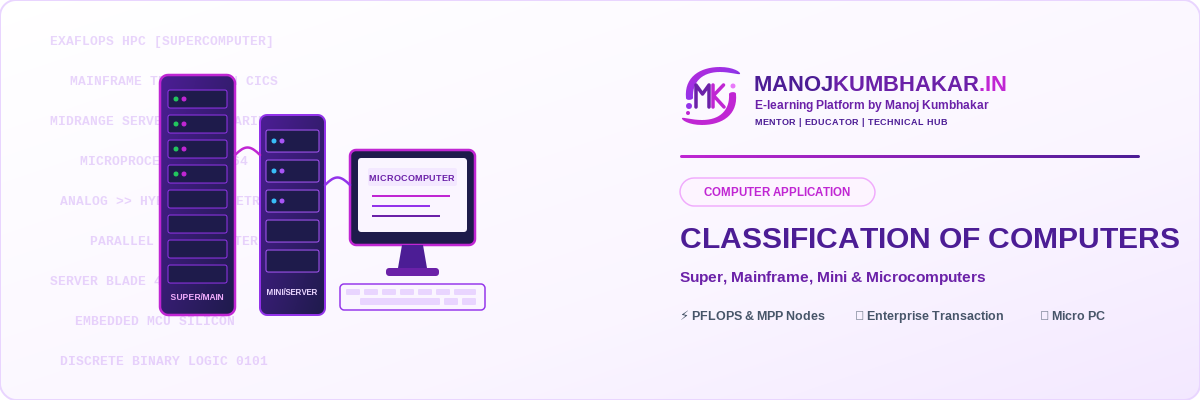
Understanding the classification of computers is a fundamental requirement in computer science education, higher secondary board curricula, and vocational information technology training. Modern computational engines have evolved far beyond basic counting devices into multi-tiered electronic architectures. Today, the classification of computers is evaluated across three primary dimensions: operational data handling (Analog, Digital, Hybrid), functional purpose (General vs. Special Purpose), and most critically, computational scale, processing throughput, memory architecture, and concurrent multi-user capacity.
- Supercomputers: Massively parallel processing clusters delivering scientific calculations measured in Floating-Point Operations Per Second (PFLOPS, EFLOPS).
- Mainframes: Fault-tolerant enterprise engines optimized for massive I/O bandwidth and millions of simultaneous database transactions.
- Minicomputers: Midrange multi-user servers built for departmental workloads, manufacturing control, and university labs.
- Microcomputers: Single-chip microprocessor designs engineered for individual productivity, workstations, laptops, and embedded devices.
1. Classification of Computers by Operational Principles
Before grouping hardware by physical size, systems are classified by how data is physically received and computed within internal circuitry:
- Analog Computers: Process continuous physical variables such as electrical voltage, hydraulic pressure, fluid dynamics, or temperature. Rather than converting values into numeric digits, analog circuits solve differential equations in real time using operational amplifiers.
- Digital Computers: Calculate information exclusively using discrete discontinuous binary states (0s and 1s). Operating in accordance with standardized computer basics architecture and machine cycles, digital systems execute mathematical arithmetic and Boolean logic with absolute precision[cite: 1].
- Hybrid Computers: Integrate the high-speed continuous processing of analog machines with the logical storage and numerical accuracy of digital systems. As detailed in computing studies indexed in the ACM Digital Library, hybrid processors are standard in intensive care medical equipment (ICUs), radar tracking arrays, and aerospace guidance systems.
Figure 1: Architectural hierarchy and operational scope across the classification of computers.
2. Classification of Computers by Size, Speed, and Hardware Scale
When evaluated by size, processing power, and multi-user concurrency, systems are organized into four major categories:
A. Supercomputers: High-Performance Computing (HPC)
Supercomputers represent the peak of computational capacity. Designed specifically for mathematical modeling and floating-point computations, supercomputers do not measure performance using standard processor clock speed; instead, they are benchmarked by FLOPS (Floating-Point Operations Per Second). Modern supercomputers exceed Petaflops ($10^{15}$) and operate in the Exaflops ($10^{18}$) range.
These systems link thousands of coordinated CPUs and GPUs via high-speed, low-latency interconnects, backed by specialized storage devices and memory architecture like High Bandwidth Memory (HBM)[cite: 1]. Prominent installations tracked on the bi-annual TOP500 Supercomputing List include Frontier, Fugaku, and India’s PARAM series (such as PARAM Siddhi-AI).
Key Use Cases: Quantum mechanical calculations, planetary climatology forecasting, aerodynamic simulations, molecular dynamics, and cryptographic verification.
A common point of confusion in computer applications is treating supercomputers and mainframes as interchangeable. Supercomputers focus on pure calculation speed, allocating massive processing power toward solving a single complex computational task at maximum velocity. In contrast, Mainframes focus on I/O throughput and concurrent transaction processing, managing millions of simultaneous queries from tens of thousands of users without data corruption or service interruption.
B. Mainframe Computers: High-Volume Transaction Engines
Mainframe computers are enterprise-scale systems designed for continuous, uninterrupted operation, extreme I/O bandwidth, and high reliability (“five nines” or 99.999% uptime). While supercomputers tackle raw mathematical equations, mainframes process high volumes of simultaneous database lookups, electronic financial transactions, and commercial records.
Mainframe architectures isolate processing work using specialized auxiliary channel subsystems. These dedicated I/O processors manage peripheral storage, network communications, and transaction queues without consuming primary CPU cycles.
Key Use Cases: Global banking transaction networks, airline reservation backends (GDS), national social security administration databases, and enterprise insurance platforms (e.g., IBM zSeries systems).
C. Minicomputers: Midrange Departmental Servers
Introduced in the 1960s by Digital Equipment Corporation (DEC with the PDP and VAX families), minicomputers (or midrange computers) filled the gap between massive mainframes and early personal systems. They offered multi-user time-sharing capabilities for 20 to 200 users at a lower operational cost.
In modern client-server infrastructure, traditional minicomputers have evolved into enterprise departmental servers, database cluster nodes, and manufacturing automation controllers.
D. Microcomputers: The Personal Computing Spectrum
A microcomputer is a computing system whose Central Processing Unit is completely integrated on a single semiconductor silicon chip, termed a Microprocessor. This architectural breakthrough eliminated room-sized multi-board setups, driving the growth of personal computing:
- Desktop Computers: Modular computer systems engineered for permanent placement, offering flexible expansion across graphics cards, memory, and internal storage.
- Workstations: High-end single-user systems configured with Error-Correcting Code (ECC) RAM and multi-core processors for CAD engineering, architectural modeling, and 3D rendering.
- Laptops & Ultrabooks: Portable, battery-powered systems integrating displays, input devices, and low-power microprocessors.
- Embedded Microcontrollers: Highly compact System-on-Chip (SoC) architectures (e.g., ARM, PIC, Arduino) programmed for dedicated control logic in consumer electronics, automotive ECUs, and industrial robotics.
3. Comparative Matrix: Hardware Specifications Across Categories
The following matrix details the primary architectural and operational parameters across the classification of computers:
| Category | Core Engineering Focus | User Capacity | Performance Metric | Physical Footprint & Cost |
|---|---|---|---|---|
| Supercomputer | Raw scientific floating-point math | Task-driven (Dedicated workload) | PFLOPS / EFLOPS | Warehouse scale; Millions of USD |
| Mainframe | Massive concurrent I/O transactions | Tens of thousands simultaneously | MIPS / High I/O Bandwidth | Dedicated server hall; Enterprise budget |
| Minicomputer | Departmental time-sharing | Dozens to hundreds of terminals | Hundreds of GFLOPS / Multi-core MIPS | Single rack enclosure; Moderate cost |
| Microcomputer | Single-user general productivity | Single user (Locally) | Gigahertz (GHz) clock & IPC | Desktop or portable; Affordable |
4. Academic Review & Examination Guidelines
When answering academic board questions regarding the classification of computers, structure your explanations methodically:
- Always distinguish whether the question asks for Operational Principles (Analog, Digital, Hybrid) or Size and Capability (Super, Mainframe, Mini, Micro).
- State clearly that Supercomputers focus on calculation speed (FLOPS), whereas Mainframes prioritize high-volume concurrent transaction throughput (MIPS and I/O channels).
- Note that modern digital computers perform internal operations via binary logic, which can be translated across other representations using number system conversions[cite: 1].
5. Frequently Asked Questions (FAQ)
What are the primary criteria used in the classification of computers?
The classification of computers is structured according to operational principles (analog, digital, hybrid), general vs. dedicated purpose, and physical scale (supercomputers, mainframes, minicomputers, and microcomputers).
What is the primary difference between a mainframe and a supercomputer?
A supercomputer is built for maximum computational speed on single, complex scientific problems (measured in FLOPS). A mainframe is engineered for massive I/O transaction throughput, executing millions of independent business transactions concurrently without data loss.
Why did microcomputers replace minicomputers in everyday office environments?
The invention of the single-chip microprocessor combined with advances in VLSI semiconductor manufacturing allowed microcomputers to deliver higher computing power at lower costs, smaller physical footprints, and lower power requirements than traditional minicomputer cabinets.