
Mastering number system conversions is the foundational mathematical requirement in computer science, digital electronics, and higher secondary computer curricula. While human civilization communicates numerical values through base-10 representations, microprocessors operate through binary logic gates governed by high and low voltage states. Bridging the gap between human reasoning and computer execution requires complete fluency in converting values across Decimal, Binary, Octal, and Hexadecimal formats.
- 1. Fundamentals of Positional Number System Conversions
- 2. Decimal to Any Base: Successive Division Method
- 3. Converting Any Base to Decimal: Positional Expansion
- 4. Fast Binary to Octal and Hexadecimal Conversions
- 5. Fractional Number System Conversions: Radix Points
- 6. Frequently Asked Questions (FAQ)
- Decimal (Base 10): 10 symbols (0–9) utilized for human data interaction and software frontends.
- Binary (Base 2): 2 symbols (0, 1) directly executed by CPU logic gates and memory flip-flops.
- Octal (Base 8): 8 symbols (0–7) used in UNIX permissions and compact memory representations.
- Hexadecimal (Base 16): 16 alphanumeric symbols (0–9, A–F) for memory addresses, IPv6, and color codes.
1. Fundamentals of Positional Number System Conversions
A positional numbering structure defines the quantitative value of any digit based on three variables: the face digit, the position the digit occupies, and the base (radix) of that numerical system. The base indicates the total count of unique symbols available before place-value rollover occurs. As highlighted in foundational data standards published by the NIST Information Technology Laboratory, positional radix representations ensure consistency across multi-threaded computational workloads.
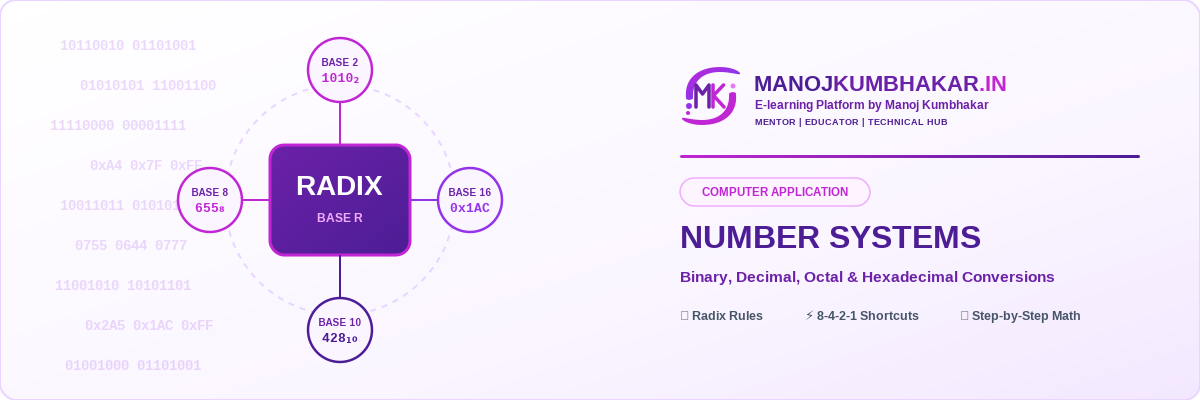
Figure 1: Core radix classifications utilized across digital number system conversions.
| System Name | Base (Radix) | Permissible Digits / Symbols | Primary Computing Application |
|---|---|---|---|
| Decimal | Base 10 | 0, 1, 2, 3, 4, 5, 6, 7, 8, 9 | User interaction, arithmetic displays, software I/O |
| Binary | Base 2 | 0, 1 | Direct execution across CPU architecture and logic registers |
| Octal | Base 8 | 0, 1, 2, 3, 4, 5, 6, 7 | UNIX terminal file permissions (e.g., chmod 755) |
| Hexadecimal | Base 16 | 0–9, A (10), B (11), C (12), D (13), E (14), F (15) | Memory addressing, IPv6 subnets, hardware MAC addresses |
2. Decimal to Any Base: Successive Division Method
When converting an integer from the Decimal system (Base 10) to another base $R$ (Base 2, 8, or 16), mathematicians employ the Successive Division Method.
Step-by-Step Procedure:
- Divide the decimal integer by the target radix ($R$).
- Record the integer remainder generated at each step.
- Continue dividing the quotient until it evaluates to 0.
- Read the remainders from bottom to top—the final remainder forms the Most Significant Digit (MSD) and the initial remainder represents the Least Significant Digit (LSD).
Example 1: Convert (75)₁₀ to Binary (Base 2)
37 / 2 = 18 Remainder: 1
18 / 2 = 9 Remainder: 0
9 / 2 = 4 Remainder: 1
4 / 2 = 2 Remainder: 0
2 / 2 = 1 Remainder: 0
1 / 2 = 0 Remainder: 1 (MSD)
Reading from bottom to top: (75)₁₀ = (1001011)₂
Example 2: Convert (428)₁₀ to Hexadecimal (Base 16)
26 / 16 = 1 Remainder: 10 (Represented as ‘A’)
1 / 16 = 0 Remainder: 1 (MSD)
Reading from bottom to top: (428)₁₀ = (1AC)₁₆
3. Converting Any Base Back to Decimal: Positional Expansion
Converting any base back to Base 10 utilizes polynomial positional expansion. Every digit is multiplied by its base raised to the power of its positional index (starting at index 0 from right to left).
Example: Convert (2A5)₁₆ to Decimal
Position 1: A (10) × 16¹ = 10 × 16 = 160
Position 0: 5 × 16⁰ = 5 × 1 = 5
Summation: 512 + 160 + 5 = 677
Result: (2A5)₁₆ = (677)₁₀
Never convert Binary to Decimal before converting to Octal or Hexadecimal during examinations. Because $2^3 = 8$, exactly 3 binary bits form 1 octal digit (4-2-1 rule). Because $2^4 = 16$, exactly 4 binary bits form 1 hexadecimal digit (8-4-2-1 rule). Grouping bits from right to left enables fast, direct conversions.
4. Fast Binary to Octal and Hexadecimal Number System Conversions
Bit-grouping techniques accelerate calculations and eliminate arithmetic division errors during tests:
A. Converting (110101101)₂ to Octal (Base 8)
Group the bits into clusters of 3 starting from the rightmost bit:
Group 2: 101 → (4 + 0 + 1) = 5
Group 1: 101 → (4 + 0 + 1) = 5
Result: (110101101)₂ = (655)₈
B. Converting (110101101)₂ to Hexadecimal (Base 16)
Group the bits into clusters of 4 starting from the right. If the leftmost group lacks digits, prepend leading zeroes:
Group 3: 0001 → (0 + 0 + 0 + 1) = 1
Group 2: 1010 → (8 + 0 + 2 + 0) = 10 (‘A’)
Group 1: 1101 → (8 + 4 + 0 + 1) = 13 (‘D’)
Result: (110101101)₂ = (1AD)₁₆
5. Fractional Number System Conversions: Handling Radix Points
Converting numbers with fractional components (e.g., $(0.625)_{10}$) requires the Successive Multiplication Technique rather than division. In accordance with standardized floating-point and fixed-point data conventions detailed in IEEE standards documentation, fractional conversions preserve numerical precision across arithmetic processors:
- Multiply the fractional remainder by the target base (e.g., 2 for binary).
- Record the resulting integer part (0 or 1).
- Take the remaining fractional residue and repeat multiplication until the fractional component evaluates to 0 or reaches the target precision limit.
- Read the recorded integers from top to bottom.
0.250 × 2 = 0.500 → Integer: 0
0.500 × 2 = 1.000 → Integer: 1 (LSD)
Result: (0.625)₁₀ = (0.101)₂
6. Frequently Asked Questions (FAQ)
What are the primary applications of number system conversions in computing?
Number system conversions allow developers and technicians to translate human-readable base-10 values into machine-level binary code, manage low-level memory addressing through compact hexadecimal notation, and configure system permissions using octal representations.
Why is the 8-4-2-1 rule effective for Binary-to-Hexadecimal conversion?
Because $16 = 2^4$, each hexadecimal digit maps directly to a 4-bit binary nibble. The weights of these four bit positions correspond to $2^3 (8)$, $2^2 (4)$, $2^1 (2)$, and $2^0 (1)$, allowing direct translation without converting to decimal first.
How does fractional binary conversion differ from integer conversion?
Integer conversion uses successive division by the target radix and reads remainders from bottom to top. Fractional conversion uses successive multiplication by the radix, recording extracted integers from top to bottom.